Imagine you are an oil trader.
On your desk are two offers:
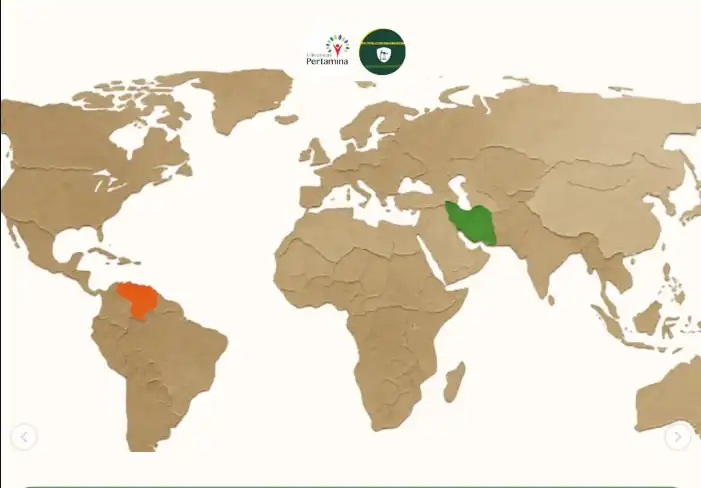
One barrel from Iran. One barrel from Venezuela.
Both are crude oil. Both are from sanctioned countries. Both are desperate to find buyers.
But you know something that most people do not know —
Not all barrels are created equal.
Round 1: Two Giants That Look Similar
Venezuela sits on 303 billion barrels of proven reserves. The largest in the world. Bigger than Saudi Arabia. Bigger than anyone.
Iran? “Only” 208.6 billion barrels. Number three in the world.
On paper, Venezuela wins by a landslide.
But the market does not read paper. The market reads reality.
Round 2: The Problem Lies Beneath the Ground
Venezuelan oil is not ordinary oil.
This is extra-heavy crude — oil so thick, so heavy, that it can barely flow on its own. Its export benchmark, Merey 16, has an API gravity of only 16.4°. Imagine pouring liquid asphalt into a pipeline.
Iran is different. Iran Heavy stands at 29.6° API — still heavy and sour, but far easier to trade. It can still enter hundreds of refineries around the world without major modification.
This is where the story begins to split into two.
Round 3: Why Is Iran More “Marketable”?
First: Scale. Iran produces in massive volumes. Asian buyers — especially China — need certainty of supply, not just small trickles.
Second: Discount. Because of sanctions, Iran sells below market price. This is not a weakness — it is a marketing weapon. China, India and other Asian buyers quietly line up.
Third: Refinery flexibility. Medium-heavy sour crude like Iran Heavy can be processed in hundreds of complex refineries without requiring special configuration. This is commercial in the truest sense.
Round 4: Then Who Wants Venezuela?
That is the right question.
Not just any buyer. Precisely the most specialized buyers in the world — refineries that were deliberately built to process heavy and ultra-heavy crude.
Refineries with high coking capacity can turn Venezuela’s heavy oil into high-value products. In the hands of the right refinery, a Venezuelan barrel is not a burden — it is a jackpot.
And when global heavy sour crude supply begins to tighten? Venezuela is not merely a backup option.
Venezuela becomes the only option.
Round 5: Geopolitics as a Shadow Game
There is one more dimension that is often forgotten.
Why does the United States keep targeting Iran?
It is not merely about nuclear issues. It is not merely about ideology.
Oil is the lifeblood of Iran’s revenue. Energy sanctions are the most effective way to pressure the regime without firing a single bullet.
This is geopolitics through energy — a war played out on top of oil contracts, not on the battlefield.
And every time Iran is threatened? The market begins to get nervous. The market begins to look for substitutes.
Iran raises risk. Venezuela gains value.
Epilogue: A Lesson from Two Barrels
In the oil industry, there is a truth that is not taught in textbooks:
Value is not determined by how large your reserves are. It is determined by how badly your oil is needed — at the right time, by the right buyer.
Venezuela has more oil. But Iran has more buyers.
Venezuela has extraordinary resources. But Iran has extraordinary accessibility.
Two giants. Two strategies. Two different market destinies.
And you, that trader from the beginning?
You already knew the answer from the start.
What you are buying is not merely oil.
You are buying certainty. You are buying compatibility. You are buying the right timing.
Not all barrels carry the same value — and now you know why.
Author: Dandi Alvayed, MSc. (PhD Scholar in Petroleum Engineering, KFUPM, Saudi Arabia)
About Author: Dandi is a PhD Scholar in Petroleum Engineering at King Fahd University of Petroleum and Minerals (KFUPM), Saudi Arabia — one of the most prestigious petroleum institutions in the world.
His academic background is solid: he earned his MSc with Distinction from KFUPM, and his BSc Cum Laude from Universitas Pertamina, Jakarta.
His expertise includes unconventional reservoirs, advanced petrophysics, and non-Darcy flow — fields that stand at the forefront of modern energy exploration. He is also actively engaged in research on hydrogen (H2) storage and CO2 sequestration, two key pillars of the future energy transition.
To date, Dandi has published more than 8 peer-reviewed publications in international journals, and has spoken on prestigious global stages including ARMA 2023, OPES 2024, and ADIPEC 2025 in Abu Dhabi, UAE.
His industry track record includes collaborations with major names such as Pertamina, Saudi Aramco, Global Energy, and EON. In leadership, he serves as Director of Communications at IATMI KSA, Chair Program of SPE International RAS TS APAC, and Deputy Director of R&D at PPI Dunia.
He is a scientist who believes that deep technical knowledge must be communicated simply — so that energy can be understood not only by engineers, but by everyone.